
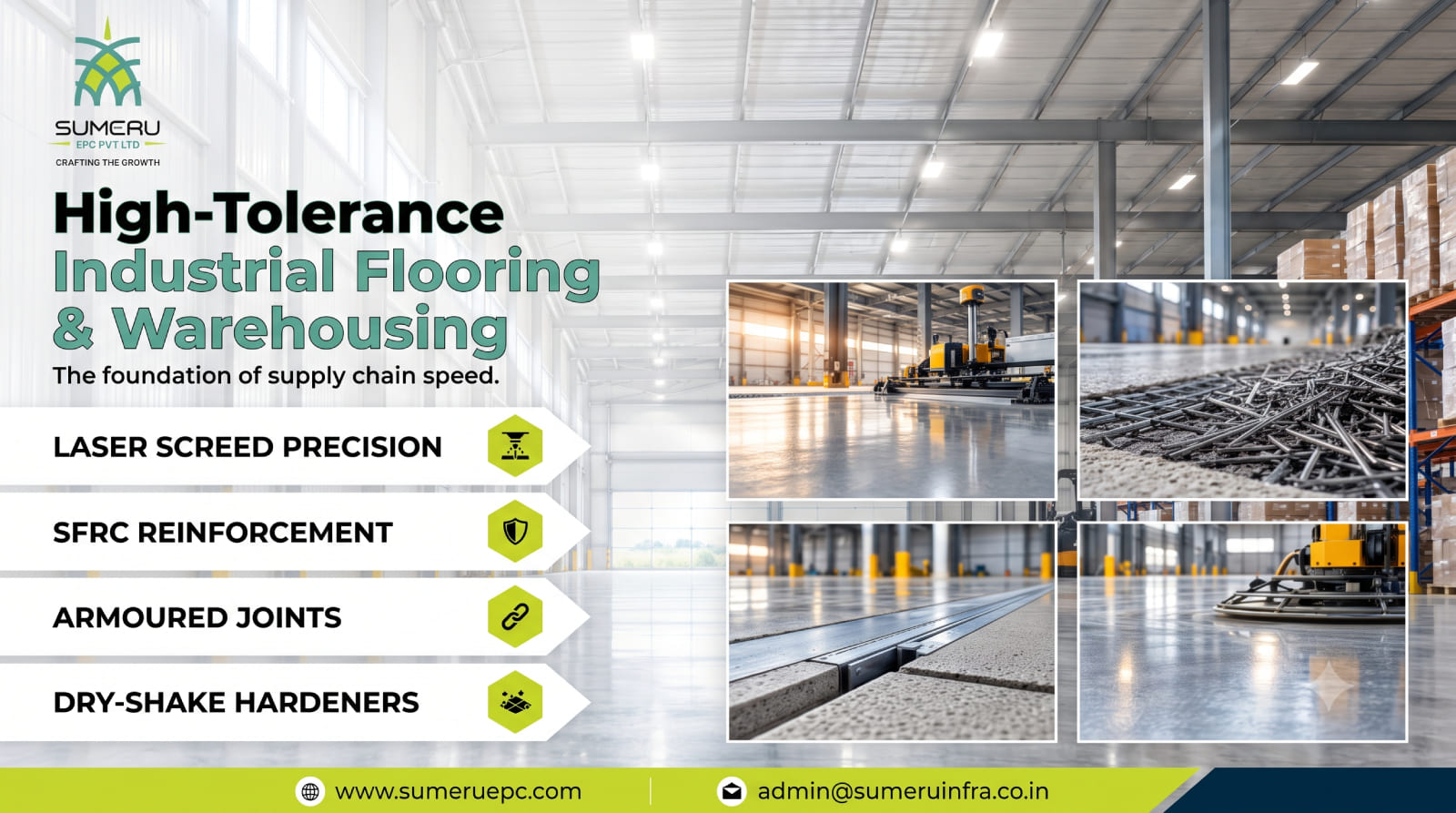
In modern automated supply chains and high-density logistics hubs, the concrete floor slab is the direct operating foundation of facility productivity. Modern Very Narrow Aisle (VNA) warehousing relies on material handling equipment (MHE) and turret trucks operating at mast heights of 12 to 17 meters with clearances measured in millimeters.
Under these operating conditions, an uneven slab can slash operational throughput by up to 25%. Minor elevation deviations at ground level amplify dramatically as reach masts extend, generating hazardous mast oscillation, triggering automated braking safety interlocks, and forcing drivers to throttle speeds.
Engineering high-efficiency logistics parks demands moving beyond basic commercial concrete slabs to high-tolerance, superflat floor systems engineered to rigorous international tolerances.
The Four Engineering Pillars of High-Speed Warehouse Floors
Building a floor slab capable of sustaining 24/7 high-density operations requires uncompromising execution controls across four critical engineering stages:
1. Laser Screed Precision & Superflat FM2 Tolerances
Manual hand-screeding and standard vibratory trusses inevitably introduce surface waves that degrade forklift tracking. Utilizing automated 3D laser screed machines allows large-area monolithic pours with uniform compaction, strictly complying with the Concrete Society’s TR34 (FM2 / Superflat) and ASTM E1155 standards to ensure dead-level travel lanes.
2. SFRC (Steel Fiber Reinforced Concrete) Matrix
Traditional welded wire mesh frequently shifts during concrete discharge and fails to control micro-cracking across large surface areas. Integrating high-tensile hooked-end steel fibers directly into the concrete mix provides three-dimensional isotropic reinforcement. This increases flexural tensile strength, enhances impact resistance, and eliminates random shrinkage cracking.
3. Armoured Joint Engineering
The vast majority of floor maintenance costs originate at slab joints. Heavy-traffic transit points and transfer aisles break down when unprotected saw-cuts chip under small, hard polyurethane wheels. Installing prefabricated leave-in-place armoured steel joints with heavy load-transfer plate dowels protects slab edges and ensures vibration-free wheel transitions under heavy axle weights.
4. Monolithic Dry-Shake Hardeners & Densification
Continuous multi-shift operations subject top surfaces to relentless abrasion. Broadcasting synthetic or metallic mineral dry-shake hardeners monolithically into the fresh concrete surface creates an ultra-dense wear layer. Subsequent treatment with penetrating chemical lithium or sodium silicate densifiers seals concrete micro-pores, eliminating concrete dust that damages sensitive barcode optics and inventory.
High-Tolerance VNA Flooring vs. Conventional Industrial Slabs
| Engineering Parameter | Conventional Industrial Slab | High-Tolerance VNA Logistics Slab |
|---|---|---|
| Surface Tolerance | Generic building tolerance (±5 to 8 mm) | Strict TR34 FM2 / Superflat specifications |
| Screeding Technology | Manual rake, hand float & vibrating beam | Automated laser screed with real-time level sensing |
| Tensile Reinforcement | Single layer wire mesh (susceptible to sagging) | Steel Fiber Reinforced Concrete (SFRC) 3D matrix |
| Joint Edge Protection | Unreinforced saw-cut joints filled with sealant | Heavy-duty armoured steel expansion edge profiles |
| Dusting & Abrasion | Prone to surface spalling under continuous loads | Monolithic metallic dry-shake + chemical densifier |
Turnkey Industrial & Civil Infrastructure Execution
A high-tolerance floor slab requires holistic geotechnical and civil integration. Sub-grade soil stabilization, plate-load bearing capacity, column footing layouts, and underground drainage must be synchronized perfectly. At Sumeru EPC Pvt. Ltd., we deliver integrated civil, structural, and turnkey industrial solutions across India:
- Heavy Industrial & High-Precision Facilities: Precision civil foundations, vibration-isolated equipment pads, and superflat production floors for facilities including the Novasys Cell Plant in Kamptee.
- Large-Span Pre-Engineered Buildings (PEB): Optimized column grids designed specifically to maximize high-bay warehouse racking layouts and internal logistical throughput.
- Clean Energy & Industrial Infrastructure: Multi-state balance-of-plant execution, site grading, and civil works delivered under zero-compromise safety standards.
Explore our industrial infrastructure capabilities across India on our Projects Directory.
Project Audit Checklist: Evaluating High-Tolerance Slab Readiness
Before casting high-bay warehouse or distribution center slabs, ensure your civil engineering team has verified these five critical benchmarks:
- MHE Dynamic Load Profile: Are the static wheel loads, dynamic wheel impacts, and mast elevation dynamics calculated against the specific MHE fleet?
- Subgrade Modulus ($k$-value): Has plate-bearing testing validated uniform sub-base compaction to eliminate the risk of long-term differential settlement?
- Third-Party Floor Profilometer Auditing: Does the QA/QC protocol mandate independent TR34 compliance verification using a calibrated walking profilometer directly after curing?
- Armoured Joint Placement: Are leave-in-place steel armoured joints aligned with racking layout aisle transitions and high-traffic arterial crossings?
- Hydration & Curing Controls: Is a controlled wet-curing blanket system enforced for a minimum of 7 to 14 days to prevent early curling and edge lifting?
Frequently Asked Questions
Why does VNA warehouse efficiency drop on uneven concrete floors?
At lift heights exceeding 10 meters, slight millimeter-level surface deviations cause dramatic mast swaying. To prevent rack collisions and load shedding, MHE operators are forced to drive significantly slower. Automated forklifts will also trip tilt-sensor safety alarms, halting operations.
What is the advantage of SFRC over standard rebar mesh in warehouse slabs?
Steel Fiber Reinforced Concrete distributes millions of high-tensile steel fibers throughout the entire slab volume. This creates continuous multi-directional reinforcement that controls micro-cracking during early thermal shrinkage and dramatically improves post-crack flexural load capacity.
How soon after casting should an industrial floor be tested for FM2 tolerance?
Surface flatness testing using an automated walking profilometer should ideally be conducted within 24 to 72 hours of casting (and re-checked after curing), ensuring that any localized deviations are identified and remediated before racking erection begins.
Deliver Precision Logistics Infrastructure with Sumeru EPC
Protect your capital investment, maximize automated picking cycles, and preserve MHE fleet longevity with precision-engineered industrial flooring.
- Email: admin@sumeruinfra.co.in
- Headquarters: 201, Deepkamal Commercial Hub-1, Sarthana Jakat Naka, Surat, Gujarat, India – 395006
- Website: www.sumeruepc.com