
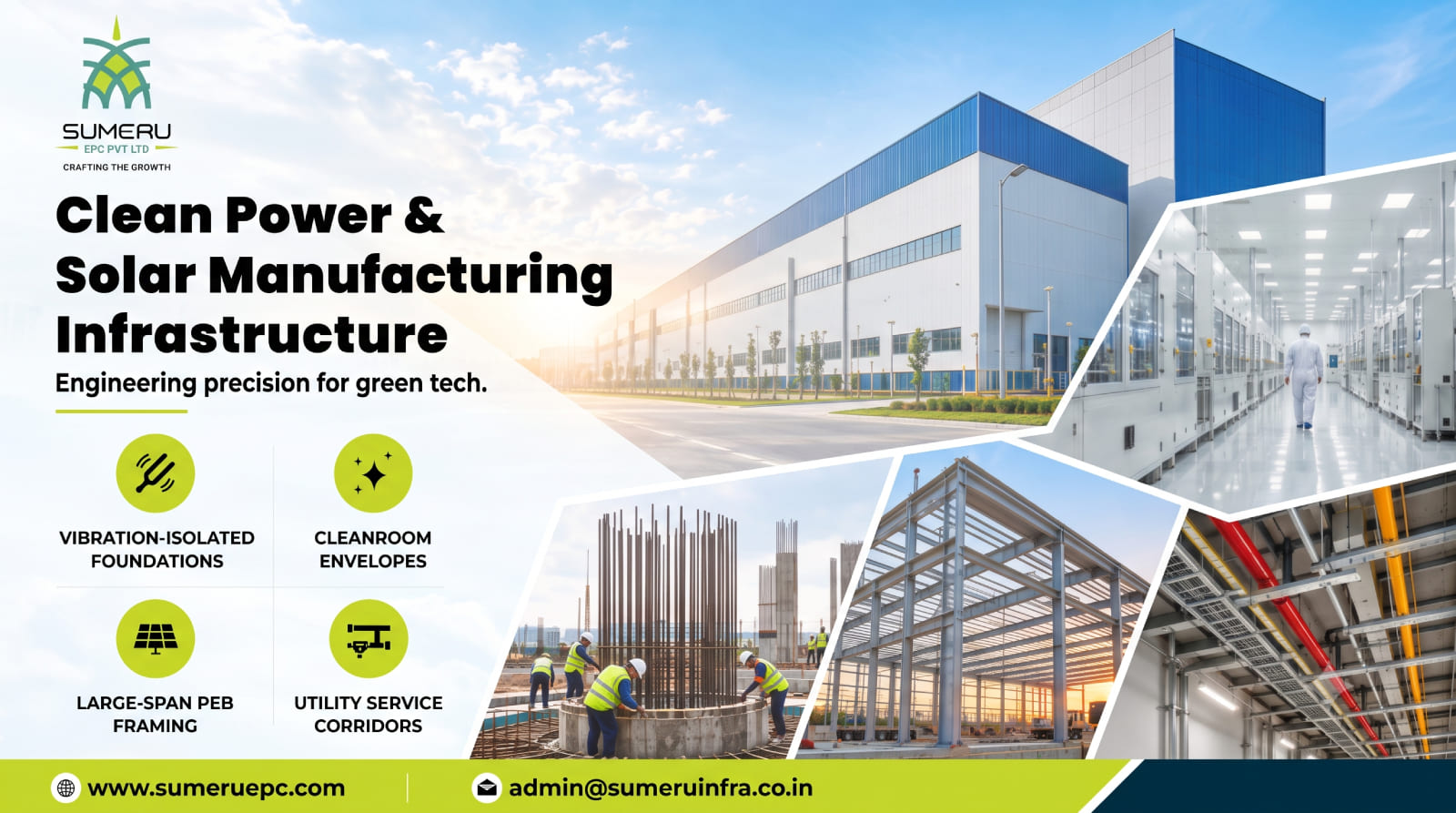
India’s ambitious clean energy transition is fundamentally anchored in domestic solar manufacturing capacity. Moving from importing modules to domestically fabricating advanced photovoltaic (PV) cells demands a transformation in industrial architecture.
Building a solar cell and module gigafactory is not comparable to erecting a standard industrial shed. Photovoltaic cell processing-spanning chemical texturing, diffusion, thin-film deposition, and robotic micro-soldering-operates within sub-micron tolerances. A tiny micro-vibration, an unsealed thermal bridge, or an uncoordinated utility line can compromise equipment calibration and severely impact cell conversion efficiency.
Delivering gigawatt-scale clean energy facilities requires strict civil, structural, and mechanical engineering precision. Below is an engineering breakdown of the structural sub-systems that make solar manufacturing facilities viable.
1. Vibration-Isolated Heavy Machine Foundations
High-speed cell stringers, tabber-stringers, automated wafer inspection vision systems, and automated guided vehicles (AGVs) cannot tolerate ground vibration. At the same time, solar plants house massive mechanical utility machinery-such as heavy chillers, central air-handling fans, and high-capacity vacuum pumps-that emit continuous dynamic oscillations.
- Mass Foundation Decoupling: Isolating machine foundations with deep perimeter expansion joints and elastomeric damping materials to isolate high-torque rotating pumps from the main cleanroom floor.
- Resonance Frequency Analysis: Structuring concrete mass ratios to ensure the natural frequency of the foundation slab does not match the operational frequency of heavy process tools.
- Sub-Millimeter Anchor Bolt Embedment: Deploying digital 3D total stations to align machine anchor bolts and baseplate channels, preventing equipment drift during high-speed production.
2. Sealed Cleanroom Envelopes & Sub-Structure Control
Solar cell production requires controlled environmental conditions (ISO Class 7 and Class 8 standards) to prevent airborne particulate contamination on silicon wafers.
- Hermetically Sealed Enclosures: Integrating insulated walk-on ceiling panels, airtight wall envelopes, and positive-pressure airlock cascades to prevent dust and particle infiltration.
- Thermal and Humidity Stabilization: Incorporating high-performance thermal insulation across walls and roof decking to maintain stable temperature (±1°C) and tight relative humidity levels, which are critical for precision metallization paste curing.
- Conductive Electrostatic Discharge (ESD) Flooring: Installing monolithic anti-static epoxy floor coatings to dissipate static electrical charges that could otherwise damage sensitive micro-circuits.
3. Large-Span Pre-Engineered Building (PEB) Framing
Modern solar cell and module production lines require continuous, straight-line material flow. Unplanned interior structural columns disrupt the line layout and hinder automated material transport systems.
- Column-Free Clear Spans: Engineering large-span Pre-Engineered Building (PEB) structural steel framing to provide wide open working bays for uninterrupted automated manufacturing and assembly lines.
- High-Capacity Roof Loading: Designing structural steel trusses capable of carrying substantial collateral dead loads, including heavy cleanroom HVAC ductwork, secondary air handling units (AHUs), piping racks, and process scrubbers.
- Integrated Overhead Crane Corridors: Incorporating runway beams for overhead cranes and gantry equipment to simplify heavy machinery installation, tooling changeovers, and ongoing maintenance.
4. High-Density Utility Service Corridors
Solar cell manufacturing is highly utility-intensive, requiring reliable delivery of Ultra-Pure Water (UPW), process chemicals, bulk gases (silane, ammonia, nitrogen), and treated electrical feeds.
- Pre-Engineered Trenches & Service Mezzanines: Designing dedicated subterranean utility corridors and walk-on overhead service mezzanines to separate chemical, gas, and power lines safely while keeping maintenance off the production floor.
- Secondary Containment & Acid-Resistant Civil Works: Constructing bunded sump zones and chemical drainage trenches lined with chemical-resistant resin coatings to safely contain aggressive acids used in etching processes.
- Industrial Effluent Treatment Infrastructure: Executing dedicated civil tanks, neutralization basins, and civil structures for Zero Liquid Discharge (ZLD) plants to ensure complete environmental compliance.
Solar Manufacturing Plants vs. Standard Industrial Factories
| Feature / System | Conventional Industrial Facility | Solar Cell & Module Manufacturing Plant |
|---|---|---|
| Foundation Dynamics | Standard concrete grade slab | Dynamic vibration-isolated mass foundations |
| Environmental Envelope | Natural or basic mechanical ventilation | Sealed ISO Cleanroom envelope with tight RH/Temp controls |
| Structural Bay Clear Spans | Standard 12m–18m column spacing | Wide-span (30m+) clear bays for continuous automated lines |
| Roof Collateral Load | Low (basic lighting & standard insulation) | Heavy collateral load (AHUs, ducting, scrubbers, piping) |
| Utility Infrastructure | Basic electrical, raw water, and sewer lines | Complex matrices: Ultra-Pure Water, specialty gases & ETP/ZLD |
Proven Infrastructure Execution Across Clean Energy
Engineering clean tech infrastructure demands an EPC contractor that can coordinate large-scale civil earthworks, precision foundations, structural steel, and utility lines under a unified master plan. Sumeru EPC Pvt. Ltd. provides turnkey engineering and construction across India:
- Clean Tech & Solar Cell Facilities: Turnkey civil packages, heavy machine foundations, and specialized cleanroom structures for projects like the Novasys Cell Plant in Kamptee and the Avaada Cell Plant in Butibori (Nagpur, Maharashtra).
- Renewable Balance-of-Plant: Large-scale civil works, site grading, and structural infrastructure for major clean energy corridors across Maharashtra.
- High-Span Industrial Sheds: Multi-state industrial and Pre-Engineered Building execution delivered under strict HSE and QA/QC standards.
Explore our project footprint across India on our Projects Directory.
Technical Audit Checklist: Solar Manufacturing Plant Construction
Before breaking ground on a high-tech clean power facility, verify that your engineering team has addressed these five core requirements:
- Dynamic Machinery Load Sign-Off: Are foundation thicknesses and vibration isolation joints matched to OEM machine datasheets?
- Rooftop Collateral Load Allowances: Has the PEB structural framing been calculated to carry all future AHUs, scrubbers, and suspended MEP racks without mid-span deflection?
- Sub-Slab Utility Pre-Planning: Are chemical drainage sleeves, UPW passages, and grounding grids coordinated prior to pouring blinding concrete?
- Floor Flatness & Levelness Standards: Does the civil contract specify laser screed superflat tolerances (such as TR34 FM2) to support AGVs and automated equipment?
- Zero-Incident HSE Protocols: Is the contractor equipped to enforce strict health, safety, and environmental protocols during heavy structural lifting and high-elevation work?
Frequently Asked Questions
Why do solar manufacturing facilities require vibration-isolated foundations?
Precision equipment such as automated wafer stringers, lasers, and optical inspection cameras operate at sub-millimeter tolerances. High-frequency vibrations from heavy industrial chillers and compressors can travel through standard connected slabs, throwing sensitive machinery out of alignment and causing high defect rates.
How does Pre-Engineered Building (PEB) design benefit solar plants?
PEB structures provide wide column-free spans that allow uninterrupted layouts for automated solar cell lines. Factory-engineered steel components also speed up on-site erection while easily handling high rooftop loads from cleanroom HVAC systems and exhaust scrubbers.
What is the role of specialized utility corridors in clean tech plants?
Solar manufacturing requires continuous feeds of Ultra-Pure Water, compressed air, hazardous gases, and power. Coordinated subterranean trenches and overhead service mezzanines keep these complex utility networks organized, separated for safety, and accessible for maintenance without disturbing production cleanrooms.
Industry Note: Review the executive discourse and engineering observations for this facility on LinkedIn →
Build High-Precision Clean Power Infrastructure with Sumeru EPC
Protect your capital investment, streamline your path to commercial production, and build clean energy manufacturing facilities engineered for long-term operational performance.
- Email: admin@sumeruinfra.co.in
- Headquarters: 201, Deepkamal Commercial Hub-1, Sarthana Jakat Naka, Surat, Gujarat, India – 395006
- Website: www.sumeruepc.com