
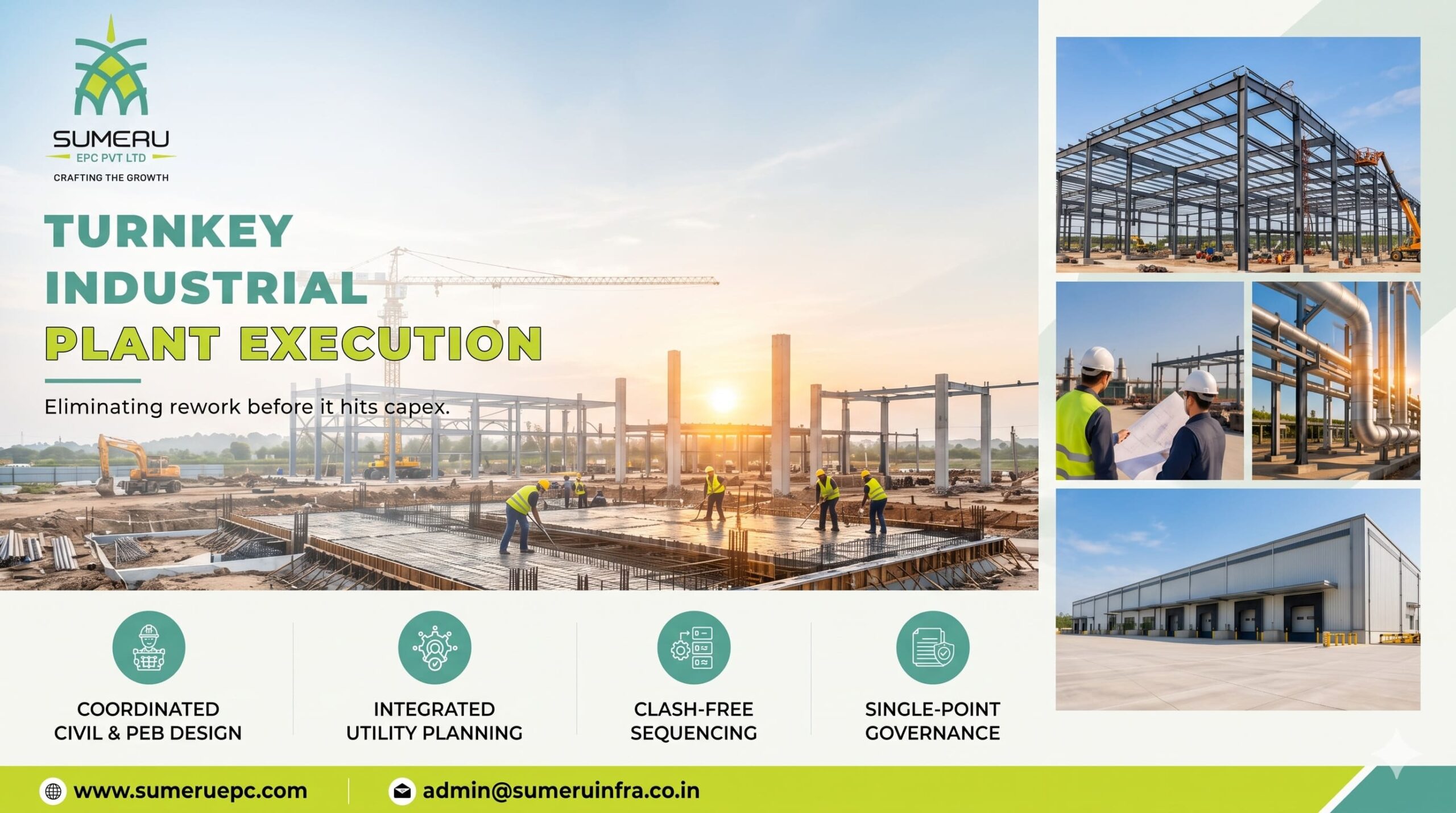
In greenfield industrial plant construction, the most damaging threat to capital expenditure (Capex) rarely stems from upfront material prices. It emerges in the friction between disjointed contractors during on-site execution. When civil contractors, Pre-Engineered Building (PEB) fabricators, process piping specialists, and electrical MEP teams operate under isolated scopes, engineering mismatches are discovered only after materials are installed.
By the time an anchor bolt misses an embed plate or an underground utility line clashes with a primary machinery footing, the remedy requires destructive concrete chipping, structural retrofits, and prolonged commissioning delays.
Turnkey industrial plant execution de-risks capex by synchronizing civil, structural, and mechanical disciplines before ground is broken, shifting risk mitigation from retroactive site firefighting to front-end engineering discipline.
The Hidden Costs of Contractor Fragmentation
Splitting a greenfield industrial facility into separate packages might seem cost-competitive during initial tendering, but it transfers enormous coordination burdens onto project promoters and Project Management Consultants (PMCs). Common site clash points include:
- Anchor Bolt & Baseplate Misalignment: Civil teams cast massive pedestals using generic drawings, only to discover that the structural steel fabricator modified baseplate slot tolerances, requiring expensive epoxy chemical anchor retrofitting.
- Slab Penetration & Core-Drilling: Inadequate pre-pour routing forces mechanical contractors to core-drill through freshly poured, fiber-reinforced concrete slabs to lay high-voltage electrical conduits and drainage pipelines.
- Cascading Schedule Delays: When a civil contractor slips by three weeks, structural erection halts, mobile crane rentals sit idle, and downstream mechanical commissioning gets pushed out, burning non-recoverable capital.
Turnkey delivery eliminates this finger-pointing dynamic by establishing a single point of technical and operational accountability.
4 Engineering Pillars of Clash-Free Turnkey Execution
[Unified 3D Spatial Coordination] ➔ [Synchronized Civil & PEB Detailing] ➔ [Pre-Cast Utility Passages] ➔ [Commissioning & Handover]
                                             │
                               Single-Contract Accountability
1. Coordinated Civil & PEB Design
Precision engineering starts by synchronizing subterranean civil foundations with superstructure fabrication files. Embed plate locations, anchor bolt clusters, and crane gantry dynamic load parameters are locked down in a unified blueprint before the first concrete batch is delivered to site.
2. Front-Loaded Utility & Process Integration
Industrial plants require massive utility networks: compressed air loops, process water, chilled lines, and high-voltage bus ducts. Turnkey execution maps all service sleeves, sub-slab utility trenches, and wall penetrations directly into the structural formwork, eliminating downstream structural demolition.
3. Clash-Free Spatial Sequencing
By resolving structural steel clearances, overhead crane travel buffers, and MEP ducting matrices simultaneously during pre-construction, turnkey teams identify and resolve physical clashes digitally rather than on the live plant floor.
4. Single-Point Governance & Milestone Control
Turnkey EPC centralizes site progress, procurement schedules, vendor audits, and QA/QC certifications into a unified delivery framework. Promoters interface with one accountable management team focused entirely on critical-path milestone delivery.
Turnkey EPC Delivery vs. Fragmented Multi-Vendor Sourcing
| Dimension | Fragmented Multi-Contractor Model | Integrated Turnkey EPC Model |
|---|---|---|
| Accountability | Diffused across 4–8 separate vendors | Single-point contract ownership |
| Site Clash Resolution | Handled reactively on-site (demolition/retrofitting) | Resolved proactively during pre-construction engineering |
| Sub-Slab Utilities | Cored/hacked into cured concrete after the fact | Pre-routed and cast into initial floor matrices |
| Capex Variance Risk | High (frequent change orders and idle equipment claims) | Protected through consolidated procurement & locked scopes |
| Commissioning Milestone | Sequential, cascading delays across trades | Compressed through synchronized, parallel execution |
Multi-State Turnkey Execution: Proven Infrastructure Delivery
Executing high-spec industrial plants without rework requires an EPC partner equipped with deep civil mastery, heavy equipment resources, and cross-domain discipline. At Sumeru EPC Pvt. Ltd., we deliver turnkey solutions across mission-critical sectors nationwide:
- High-Tech Manufacturing & Clean Energy: Precision heavy equipment footings, vibration-isolated mass slabs, and cleanroom civil infrastructure for facilities like the Novasys Cell Plant in Kamptee and the Avaada Cell Plant in Butibori (Nagpur, Maharashtra).
- Expansive Industrial & PEB Complexes: Large-span structural steel framing, heavy manufacturing plants, and high-tolerance industrial warehousing built to international standards.
- Large-Scale Civil & Utility Works: Extensive balance-of-plant, specialized pipe trenching, and civil infrastructure delivered under uncompromising HSE protocols.
Review our full range of completed and active industrial projects on our Projects Directory.
Capex De-Risking Checklist: Pre-Construction Plant Audit
Before breaking ground on your next greenfield manufacturing plant or facility expansion, ensure your project team has addressed these five critical areas:
- Unified Baseplate & Anchor Validation: Have anchor bolt coordinates and embed depths been cross-verified with fabrication shop drawings from the PEB vendor?
- Sub-Slab MEP Penetration Clearances: Are all drainage conduits, high-voltage trenches, and process pipe sleeves mapped and secured before authorizing concrete pours?
- Dynamic Equipment Mass Ratios: Are high-vibration machines (compressors, ball mills, extruders) set on isolated mass foundations decoupled from the main building frame?
- Crane Runway & Structural Clearances: Have hook approaches and gantry elevations been validated against internal architectural and mechanical layouts?
- Integrated Safety & QA/QC Regimen: Does the execution partner maintain a continuous, documented QA/QC inspection protocol covering raw material testing, compaction density, and weld integrity?
Frequently Asked Questions
How does turnkey execution directly eliminate capex overruns?
By coordinating civil engineering, PEB structural detailing, and MEP layouts before breaking ground, turnkey EPC prevents design clashes that lead to on-site demolition, structural retrofits, and idle contractor claims. Consolidated procurement also insulates developers from ad-hoc site purchases.
What causes the most common clashes between civil and PEB contractors?
The most frequent clashes occur when civil foundations and anchor bolts are poured according to preliminary drawings, while the PEB fabricator produces structural steel based on updated shop drawings. Turnkey EPC prevents this by locking both disciplines under a single engineering model.
Can turnkey plant execution compress project go-to-market timelines?
Yes. Unlike traditional contracting where civil work must completely finish before structural vendors mobilize, turnkey EPC runs engineering workflows concurrently. Off-site steel fabrication, ground stabilization, and foundation casting proceed simultaneously, moving up facility commissioning by months.
Build Your Next Industrial Facility with Sumeru EPC
Protect your capital investment, eliminate site coordination gaps, and bring your greenfield manufacturing facility online on schedule with a single, accountable engineering partner.
- Email: admin@sumeruinfra.co.in
- Headquarters: 201, Deepkamal Commercial Hub-1, Sarthana Jakat Naka, Surat, Gujarat, India – 395006
- Website: www.sumeruepc.com