
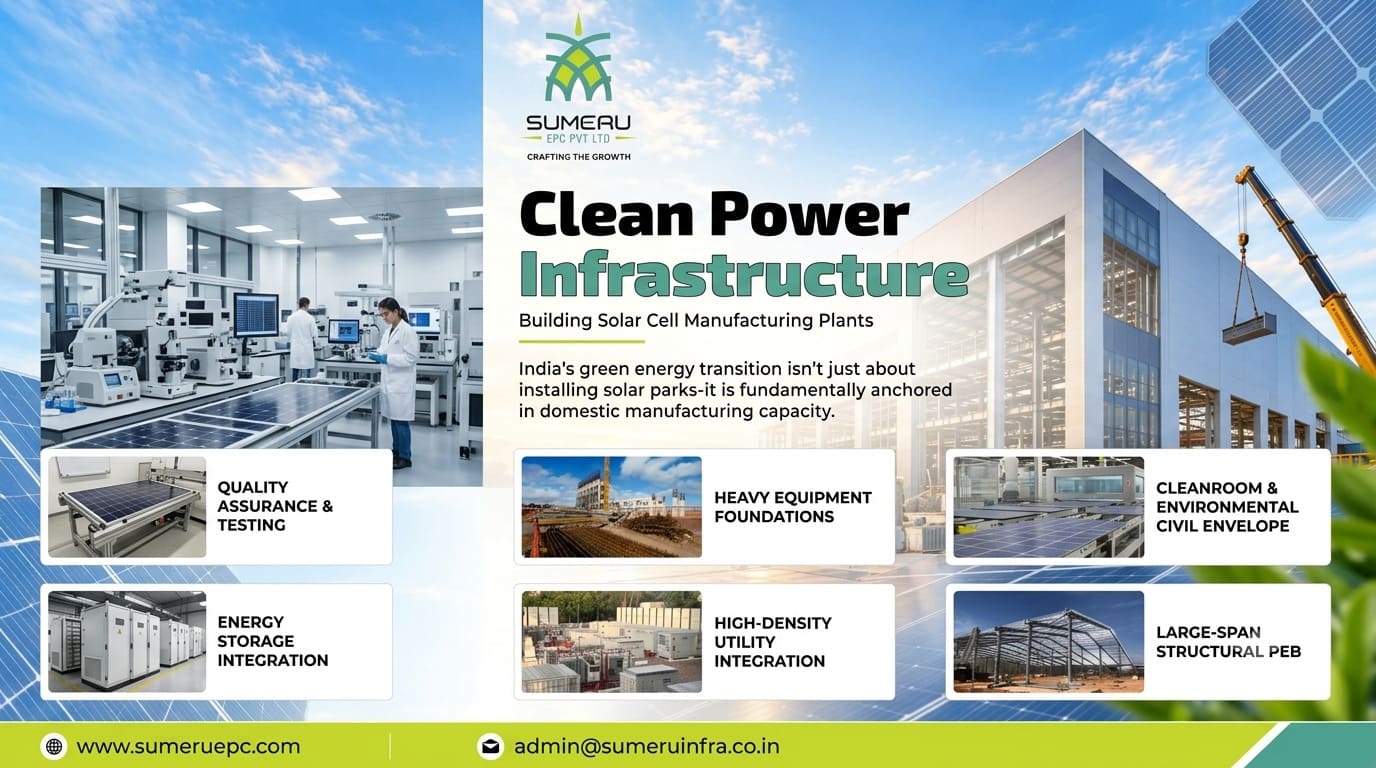
India’s rapid push toward energy independence and domestic clean power manufacturing has sparked a wave of high-tech manufacturing capacity. Yet, constructing a photovoltaic (PV) solar cell and module facility is fundamentally distinct from building conventional warehouses or standard industrial sheds.
Solar cell manufacturing is a micro-precision, chemical-intensive process. From wafer wet-chemical etching to diffusion, anti-reflective coating, and automated metallization, production lines demand uncompromising environmental isolation. For developers and PMCs, success is determined not just by process machinery, but by the civil, structural, and cleanroom infrastructure engineered beneath and around it.
Here is an engineering overview of what goes into executing clean power infrastructure and high-efficiency solar cell manufacturing facilities.
1. Sub-Micron Vibration Control & Ultra-Flat Industrial Flooring
High-speed automated cell sorting, screen printing, and wafer-handling robotics cannot tolerate floor deflection or dynamic mechanical vibration.
- Heavy Machine Dynamic Foundations: Separating heavy utility equipment (such as chillers, large air compressors, and vacuum pump skids) from cleanroom production bays using deep vibration isolation joints.
- Superflat FM2 / DM2 Floor Finishes: Laying large-pour, jointless floor slabs with sub-millimeter levelness to prevent automated guided vehicles (AGVs) and delicate robotic arms from throwing calibration errors.
- Anti-Static & Chemical-Resistant Coatings: Installing multi-layer conductive epoxy and electrostatic discharge (ESD) flooring systems to protect micro-patterned silicon wafers from electrostatic failure and chemical corrosive spills.
Controlled Cleanroom Enclosures & High-Load Structural Integration
Solar cell wet processing and coating bays mandate rigorous ISO Class cleanroom standards to keep microscopic airborne contaminants from ruining cell conversion efficiency.
- High-Span PEB Hybrid Frameworks: Designing wide-span Pre-Engineered Building (PEB) superstructures engineered to support heavy rooftop mechanical loads, including high-capacity HVAC ducting, secondary air-handling units (AHUs), and exhaust scrubbers.
- Hermetic Building Enclosures: Integrating modular, fire-rated cleanroom paneling, insulated walk-on false ceilings for maintenance crews, and airtight interlocks to maintain strict positive/negative pressure cascades.
- Thermal & Moisture Barriers: High-performance building insulation systems engineered to maintain round-the-clock temperature tolerances (±1°C) and relative humidity control vital for chemical paste curing.
3. High-Purity Utilities & Chemical Corridors
The lifeblood of a solar cell facility lies within its process utilities: Ultra-Pure Water (UPW), specialty gas lines (such as silane and ammonia), bulk chemicals, and industrial effluent treatment plants (ETP).
- Sub-Slab Utility Trenches & Mezzanines: Pre-engineering dedicated utility distribution corridors, service mezzanines, and double-containment drainage lines directly into the civil masterplan.
- Hazardous Chemical Drainage & Secondary Containment: Constructing acid-resistant, bunded concrete sumps and trenches lined with chemical-grade membranes to isolate aggressive acids (HF, HNO3) used in texturing and etching.
- Effluent Treatment Plant (ETP) Civil Works: Building civil retention basins, neutralization tanks, and Zero Liquid Discharge (ZLD) plant infrastructure to guarantee total environmental compliance.
Solar Cell Plant Infrastructure vs. Standard Industrial Construction
| Engineering Dimension | Standard Industrial Factory | Solar Cell Manufacturing Facility |
|---|---|---|
| Environmental Control | Natural ventilation or basic comfort cooling | Sealed ISO Class cleanrooms with strict RH/Temp control |
| Slab Tolerance | Standard industrial grade slab | Superflat FM2/DM2 with vibration-isolated mass foundations |
| Utility Integration | Basic power, raw water, and air lines | Ultra-Pure Water (UPW), hazardous gases, and dual-piping ETP |
| Structural Roof Load | Dead load + wind load | High-capacity loading for MEP racks, AHUs, and scrubbers |
| Flooring Specification | Standard concrete hardener | Anti-static ESD flooring with acid/alkali resistance |
Proven Infrastructure Execution in Solar & Clean Tech
Constructing high-spec renewable infrastructure requires a single EPC partner with multi-discipline capability across civil works, PEB structural engineering, and heavy industrial utility routing. Sumeru EPC Pvt. Ltd. brings proven execution across key solar and clean technology sectors across India:
- Solar Cell & Clean Tech Facilities: Execution of clean manufacturing civil works and heavy foundation packages, such as the Novasys Cell Plant in Kamptee and the Avaada Cell Plant in Butibori (Nagpur, Maharashtra).
- Utility-Scale Solar Corridors: Extensive balance-of-plant, heavy earthworks, and specialized ground-mounted civil infrastructure for projects like the Avaada Solar Projects across Maharashtra and the Gopin Solar Plant in Surat.
- Heavy Industrial & Pre-Engineered Works: Large-scale industrial buildings demanding rigorous schedule discipline and strict HSE protocols.
Discover our full range of clean energy and industrial infrastructure projects on our Projects Directory.
Client Checklist: Evaluating an EPC Partner for Solar Manufacturing
Before awarding a solar cell or module manufacturing infrastructure contract, confirm these critical capabilities:
- Cleanroom Coordination Experience: Can the contractor demonstrate seamless scheduling between structural PEB erection, cleanroom paneling, and HVAC installation without interface disputes?
- High-Precision Foundation QA/QC: Does the civil team have proven capabilities in delivering jointless superflat flooring and vibration-isolated equipment foundations?
- Hazardous Chemical Containment Expertise: Are they experienced in constructing acid-proof retention structures and sub-grade chemical drainage channels?
- Compressed Milestone Execution: Can they execute earthworks, structural steel fabrication, and utility trenching concurrently to match aggressive clean energy rollout timelines?
- Zero-Tolerance HSE Protocols: Does the contractor maintain strict safety procedures for working at heights, heavy structural lifting, and clean-environment execution?
Frequently Asked Questions
Why does solar cell manufacturing require specialized civil engineering?
Solar cell production involves sensitive wafer handling, automated optical alignment, and dangerous chemical processes. Floor vibrations or micro-level floor unevenness can misalign precision machinery, while improper drainage or inadequate building envelopes compromise cleanroom integrity and product yield.
How does turnkey EPC expedite solar plant construction?
Under a turnkey model, civil foundation design, structural PEB fabrication, and utility pathway routing are resolved concurrently in pre-construction. This prevents the common site clashes that occur when civil and cleanroom MEP contractors work under separate, disconnected contracts.
What are the key floor slab requirements in solar cell plants?
The floors require superflat tolerances (such as FM2 standards) to ensure robotic AGVs run smoothly, deep isolated machine pads to absorb compressor and pump vibrations, and electrostatic discharge (ESD) anti-static epoxy finishes to protect electronic components.
Build Your Clean Power Facility with Sumeru EPC
Whether you are setting up a greenfield solar cell plant, expanding a PV module assembly facility, or building utility-scale balance-of-plant infrastructure, Sumeru EPC provides the single-point engineering discipline needed to bring your facility online on schedule.
- Email: admin@sumeruinfra.co.in
- Headquarters: 201, Deepkamal Commercial Hub-1, Sarthana Jakat Naka, Surat, Gujarat, India – 395006
- Website: www.sumeruepc.com