
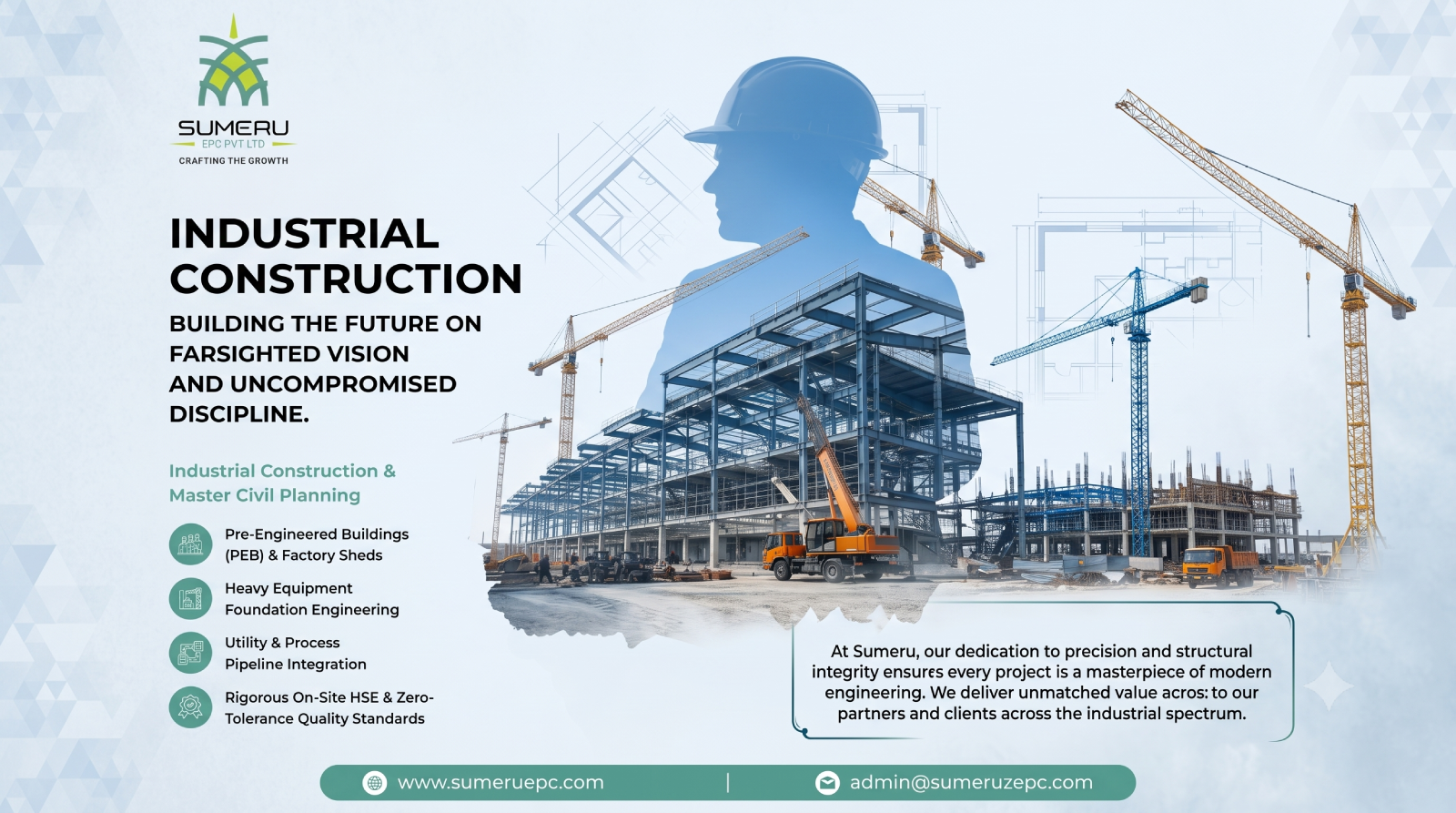
Choosing an industrial construction company in India for a greenfield plant or facility expansion usually comes down to one question buyers don’t ask early enough: will this civil work still be sound in fifteen years, under full operational load? Enduring industrial infrastructure isn’t built on speed alone – it’s built on farsighted vision and uncompromised structural discipline, decided at the planning stage, long before steel goes up. This guide covers what actually goes into turnkey industrial construction, what to check before awarding a contract, and where Sumeru EPC fits as an execution partner.
What Determines Long-Term Reliability in Industrial Construction
Two plants can look identical on commissioning day and diverge completely five years later. The difference almost always traces back to five decisions made at the planning and execution stage, not the finishing stage:
- How the ground was surveyed and leveled before a single footing was poured.
- Whether foundations were engineered for actual equipment loads – not generic slab assumptions.
- How utility and process pipelines were routed and integrated into the structural sequence.
- The rigor of on-site safety and quality control during execution, not audited after the fact.
- Whether the civil masterplan left room for future expansion without re-engineering the site.
Any credible industrial construction company in India should be able to speak to all five in detail – not just cost and timeline.
What a Turnkey Industrial Construction Company Should Deliver
“Turnkey” gets used loosely in this industry. In practice, a genuine turnkey industrial construction scope means one contractor is accountable end-to-end: master civil planning, structural erection, foundation engineering, utility integration, and safety compliance – under a single execution timeline, not five separate vendors handing off (and disclaiming) at each boundary. That single-accountability model is what actually protects a client’s schedule and budget, because there’s no gap between trades for problems to fall into.
Sumeru EPC’s Scope: Industrial Construction Across India
At Sumeru EPC Pvt. Ltd., we specialize in end-to-end industrial construction for greenfield plants and facility expansions, executed pan-India for manufacturing, process, and energy-sector clients.
Industrial Construction & Master Civil Planning – site grading, ground preparation, and a masterplan that sequences civil, structural, and utility works so later expansion doesn’t require rework.
Pre-Engineered Buildings (PEB) & Factory Sheds – large-span steel structures engineered for manufacturing floors, warehousing, and process buildings, balancing speed of erection with load and wind-zone compliance.
Heavy Equipment Foundation Engineering – foundations designed around actual machine loads, vibration profiles, and anchor-bolt layouts for the specific equipment being installed, not generic slab assumptions.
Utility & Process Pipeline Integration – civil works coordinated with process piping, utility routing, and service corridors so mechanical and civil trades don’t conflict mid-project.
Rigorous On-Site HSE & Zero-Tolerance Quality Standards – safety and quality control enforced through every execution phase, not audited after the fact.
A Client’s Checklist Before Awarding an Industrial Construction Contract
- Ask for the site’s geotechnical and ground survey data, not just a quoted foundation design – soil-bearing capacity drives everything downstream.
- Confirm foundations are engineered per the actual equipment datasheet (load, vibration, anchor pattern), not a standard template reused across projects.
- Check how utility and process pipeline routing is coordinated with the civil masterplan before structural work begins, to avoid costly rerouting later.
- Ask what HSE protocol is enforced on-site – request the safety framework and incident-reporting process, not just a certification claim.
- Confirm the masterplan accounts for future expansion – phased capacity growth should be possible without re-engineering existing foundations or structures.
- Request an execution timeline broken down by phase (site prep, foundation, PEB erection, utility integration) so progress can be tracked against real milestones.
Common Mistakes in Industrial Construction Execution
- Treating ground preparation as a formality rather than the foundation of everything built afterward – inadequate leveling or drainage planning shows up as structural issues years later.
- Using standard foundation designs for non-standard equipment – heavy or high-vibration machinery needs foundations engineered to its specific datasheet, not a reused template.
- Sequencing utility/process piping after structural steel is up, forcing rework, rerouting, or clashes that a coordinated masterplan would have avoided.
- Auditing safety and quality after milestones, instead of enforcing standards continuously through execution – by the time a gap is found, it’s already built in.
- Designing only for day-one capacity, leaving no room in the civil plan for the facility to expand without a full re-engineering exercise.
Frequently Asked Questions
What does a turnkey industrial construction company actually handle?
A turnkey industrial construction company manages the project end-to-end – master civil planning, ground preparation, structural erection (including PEB), foundation engineering, utility and process pipeline integration, and on-site safety compliance – under one accountable contract rather than multiple separate vendors.
How long does industrial construction take for a greenfield plant?
Timelines vary by site size, soil conditions, and structural scope, but a phased schedule (site prep → foundation → PEB erection → utility integration) should be defined and shared before contract award, so progress can be tracked against real milestones rather than a single end date.
What’s the difference between a PEB structure and conventional industrial construction?
Pre-Engineered Buildings (PEB) use factory-fabricated steel components engineered for large spans, allowing faster on-site erection than conventional structural steel or RCC framing, while still meeting load and wind-zone compliance for manufacturing and warehousing use.
Why does foundation engineering matter for heavy equipment?
Heavy or high-vibration machinery needs foundations designed around its specific load, vibration profile, and anchor-bolt layout – a generic slab foundation not engineered to the equipment datasheet can lead to structural issues or equipment misalignment over time.
Does Sumeru EPC work across India or only in specific states?
Sumeru EPC executes industrial construction projects pan-India, working with manufacturing, process, and energy-sector clients on greenfield plants and facility expansions.
Where Sumeru EPC Fits
Sumeru EPC works with manufacturing, energy, and process-sector clients who need a single turnkey partner for industrial construction – from master civil planning through PEB erection, heavy foundation engineering, utility integration, and on-site HSE compliance – rather than coordinating separate vendors for each phase. Our execution is built around the principle that structural integrity and long-term operational flexibility aren’t trade-offs against speed; they’re what make the speed worth having.
Let’s Build Your Facility’s Foundation Right
If you’re planning a greenfield plant or facility expansion, our team can walk you through site assessment, foundation engineering, and a phased execution timeline suited to your project.
Talk to Our Team → admin@sumeruinfra.co.in
Sumeru EPC Pvt. Ltd. · Pan-India Execution · Turnkey Civil & Industrial Construction, CGD Pipeline Works, Solar Infrastructure & PEB Structures · sumeruepc.com