
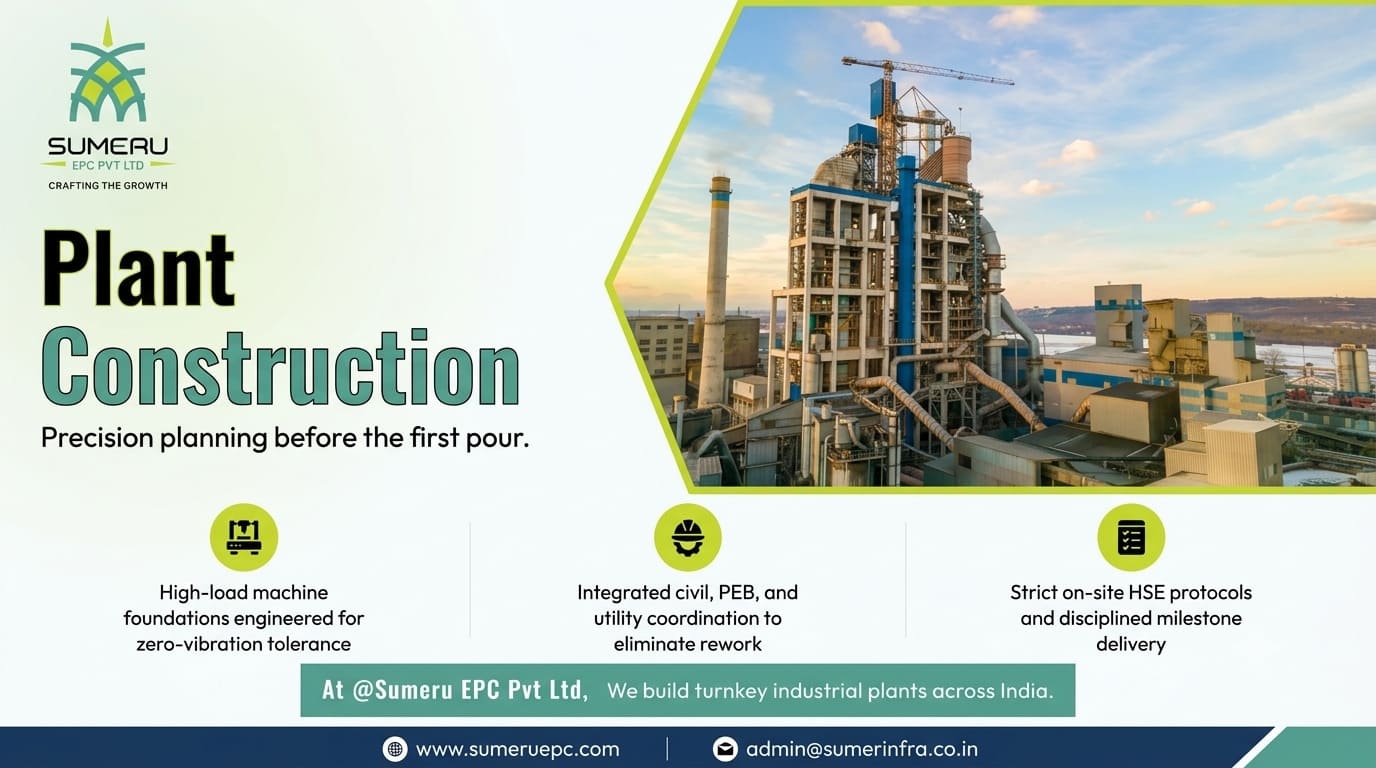
In industrial plant construction, the critical decisions that dictate a facility’s operational lifespan happen long before concrete batching trucks arrive on-site. Once concrete cures around rebar and sub-grade utility lines, design oversights become structural liabilities.
Accelerating schedules without validating soil-bearing capacities, dynamic machinery load profiles, and subsurface routing inevitably leads to slab cracking, machine misalignments, and costly downtime.
Enduring industrial infrastructure is built on pre-pour engineering discipline. Below is how integrated civil planning safeguards plant investments before the first cubic meter of concrete is poured.
1. Geotechnical Validation Beyond Generic Borehole Reports
Standard topsoil assessments are insufficient for heavy manufacturing and process facilities. Industrial plant foundations must withstand static dead loads, raw material stockpiles, and dynamic forces generated by heavy rotating machinery.
- Strata Mapping: Conducting multi-depth plate load and standard penetration tests across the entire plant footprint to identify differential settlement zones.
- Ground Improvement: Executing lime stabilization, stone column installation, or controlled compaction where bearing capacities fail to meet equipment tolerance limits.
- Drainage & Sub-Base Integrity: Engineering sub-grade drainage channels to prevent water table fluctuations from compromising the base slab over seasonal monsoon cycles.
2. Dynamic Foundation Design Matched to Machine Datasheets
A common cause of structural degradation in production plants is mounting high-vibration machinery onto standardized industrial slabs.
- Vibration Isolation: Engineering isolated mass foundations with specialized dampening joints for high-torque equipment like turbines, ball mills, extruders, and heavy compressors.
- Anchor Bolt Precision: Setting anchor bolts and insert plates with sub-millimeter survey accuracy using total station alignments to match OEM mechanical equipment baseplates.
- Reinforcement Detailing: Structuring high-density rebar cages that account for thermal expansion, fatigue stress, and dynamic resonance frequencies.
3. Sub-Slab Utility and MEP Routing Matrix
Excavating or core-drilling into a freshly cured floor slab to lay missed utility sleeves weakens structural integrity and delays mechanical commissioning.
- Underground Clash Detection: Mapping process pipelines, chemical drainage conduits, electrical cable trenches, and compressed air loops in a coordinated 3D civil-MEP layout.
- Sleeve Encapsulation: Placing high-pressure conduits, sleeves, and earth-pit terminals before laying the sub-base and pouring blinding concrete.
- Expansion Joint Coordination: Aligning process utility crossings with floor slab movement joints to avoid shearing pipes under operational load shifts.
| Engineering Factor | Standard Site Practice | Precision Pre-Pour EPC Approach |
| Soil Analysis | Single-point topsoil sampling | Comprehensive strata mapping & settlement analysis |
| Foundation Layout | Standardized vendor slab templates | Custom dynamic load-matched concrete foundations |
| Utility Sleeves | Cut or cored into cured slabs after structural work | Pre-embedded utility matrices coordinated with MEP |
| Survey Verification | Manual string-line alignments | 3D Total Station sub-millimeter coordinate verification |
| QA/QC Protocol | Post-pour core testing after curing | Continuous pre-pour rebar inspection & slump QA/QC |
Proven Industrial Execution Across India
Flawless civil execution requires an EPC partner capable of uniting complex geotechnical works with structural steel assembly and utility networks. Sumeru EPC Pvt. Ltd. delivers specialized civil and industrial infrastructure solutions nationwide:
- Heavy Manufacturing Foundations: Precision civil footings, deep pile caps, and high-tolerance floor slabs for advanced manufacturing facilities such as the Novasys Cell Plant in Kamptee.
- Extensive Energy Infrastructure: High-volume earthworks, continuous grading, and civil balance-of-plant delivery for clean energy hubs across Maharashtra.
- Complex Architectural Civil Works: High-tolerance structural frameworks and reinforced RCC landmarks including Naad Brahma in Gandhinagar.
Review our full portfolio of manufacturing plants, commercial expansions, and utility infrastructure on our Projects Directory.
The Pre-Pour Quality Audit Checklist
Before authorizing the first major concrete pour on your industrial site, verify these critical quality parameters:
- OEM Equipment Sign-Off: Have the dynamic load parameters, bolt patterns, and tolerance specifications been validated against current equipment datasheets?
- Sub-Grade Compaction Density: Has field density testing (FDT) confirmed the required 95%+ dry density standard across all foundation layers?
- Embedment Verification: Are all conduit entries, grounding loops, drainage trenches, and embed plates securely anchored against shifting during concrete vibration?
- Concrete Mix Design: Is the grade mix matched with appropriate water-reducing admixtures to avoid thermal shrinkage cracks during mass hydration?
- Weather & Curing Preparedness: Are continuous curing setups, thermal blankets, and protective coverings positioned on-site prior to batching?
Frequently Asked Questions
Why is soil strata testing critical before pouring industrial foundations?
Industrial plants subject floor slabs to heavy, cyclical dynamic loads. Inadequate soil testing can overlook soft subterranean pockets, leading to differential settlement that cracks slabs, misaligns shaft drives, and damages expensive process equipment.
How does Sumeru EPC eliminate utility clashes below grade slabs?
We run pre-construction utility coordination across all mechanical, electrical, and process piping disciplines. All sleeves, trench layouts, and earth pits are integrated into the civil blueprint and inspected on-site before pouring blinding concrete.
What measures prevent cracking in mass concrete pours?
Thermal crack control requires using low-heat hydration cement mixes, calibrated fly-ash/slag replacements, precise water-cement ratios, and continuous curing regimens tailored to local ambient conditions.
Build Your Next Industrial Plant with Sumeru EPC
Protect your capital expenditure and streamline your go-to-market timeline with precision civil planning and turnkey industrial execution.
- Email: admin@sumeruinfra.co.in
- Office: 201, Deepkamal Commercial Hub-1, Sarthana Jakat Naka, Surat, Gujarat, India – 395006
- Website: www.sumeruepc.com