
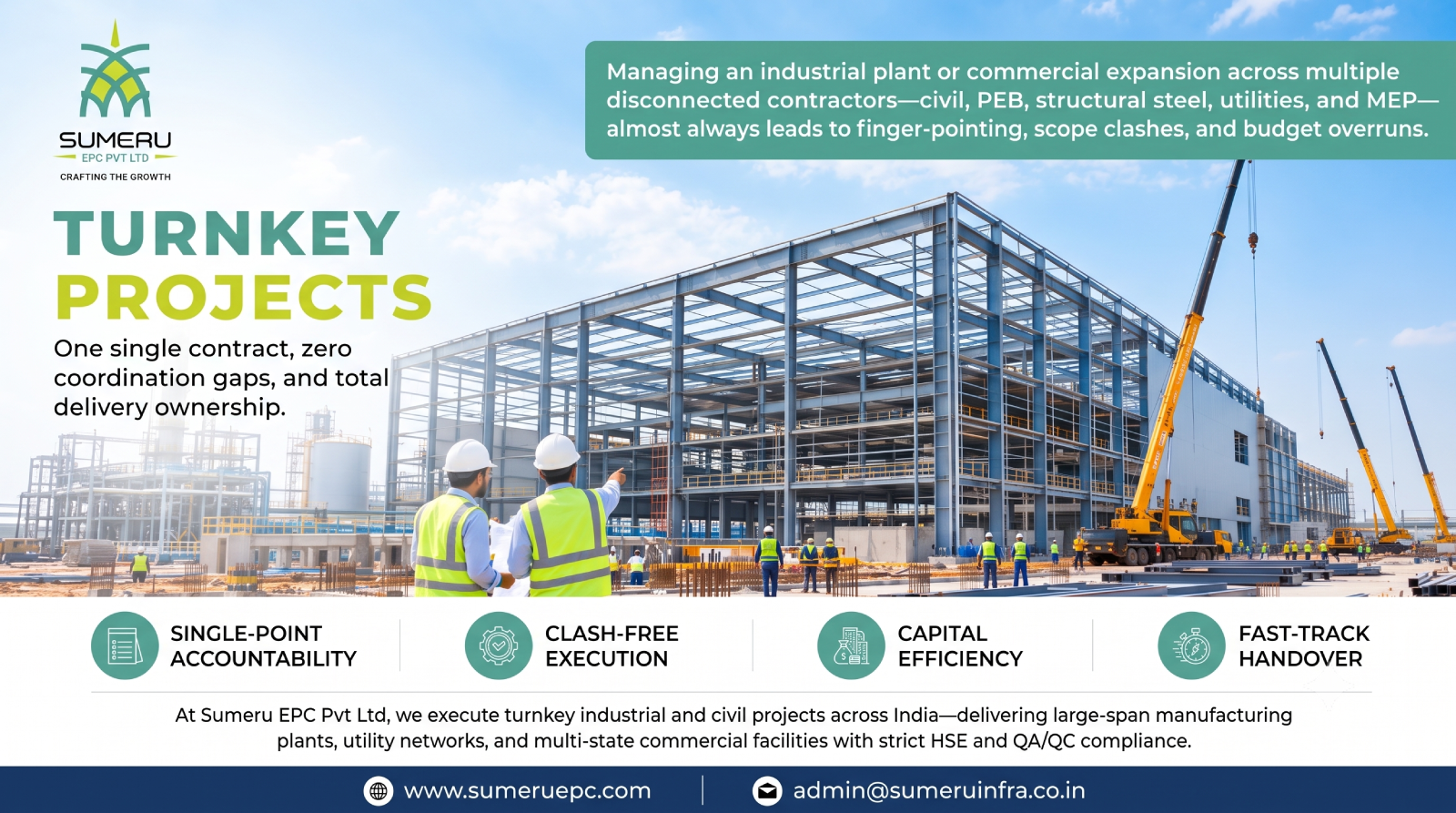
Managing an industrial greenfield plant or commercial expansion through multiple fragmented contractors is one of the most persistent drivers of budget blowouts and commissioning delays. When civil earthworks, Pre-Engineered Building (PEB) fabricators, MEP trades, and utility piping teams operate under isolated contracts, site boundaries blur into disputes. Foundations sit waiting for revised anchor bolt layouts, utility trenches cut through freshly cast grade slabs, and overall responsibility diffuses across five different vendors.
Turnkey EPC delivery replaces this multi-party coordination hazard with total lifecycle ownership. By binding master civil engineering, structural fabrication, utility distribution, and commissioning under a single contract, promoters and Project Management Consultants (PMCs) replace site friction with measurable schedule certainty.
The Flaw of Multi-Vendor Contracting in Industrial Expansions
When an industrial promoter splits a project into standalone contracts, the promoter effectively assumes the role of head coordinator and risk absorber. The true friction points emerge during inter-trade handoffs:
- The Foundation-to-PEB Interface: Civil contractors pour slabs based on preliminary drawings. When the PEB vendor delivers columns with revised baseplate specs, costly chipping and retrofit anchor installations become unavoidable.
- Subsurface Routing Clashes: Civil teams finish grading before process utility contractors finalize routing paths, forcing site teams to re-excavate compacted earth or core through finished RCC retention walls.
- Diffused Accountability: When structural handovers slip, the mechanical installer blames the structural team, the structural team blames the civil crew, and the promoter incurs idle plant costs.
Genuine turnkey execution eliminates these interface risks by holding one engineering partner accountable from ground survey to statutory handover.
Core Pillars of Turnkey EPC Delivery
1. Single-Point Accountability & Streamlined Governance
With a unified EPC partner, progress reporting, material testing certifications, and milestone tracking pass through a unified project dashboard. There are no contractor cross-claims or disputed scope gaps. If a milestone is delayed, one team is responsible for rectifying it.
2. Front-End Clash-Free Design Coordination
Turnkey projects coordinate civil, structural, and mechanical workflows concurrently during pre-construction. Heavy machinery vibration profiles, underground conduit pathways, and structural load distributions are resolved inside an integrated spatial coordination model prior to pouring concrete.
3. Direct Capital Efficiency & Bulk Procurement
Fragmented bidding introduces redundant contractor margins, fragmented logistics charges, and piecemeal raw material orders. An integrated turnkey partner leverages centralized procurement frameworks for structural steel, aggregate, cement, and high-spec industrial valves protecting project capex against interim commodity price spikes.
4. Compressed Timelines to Plant Monetization
Conventional multi-contract approaches operate sequentially: site grading finishes, then foundations begin; structural frames stand, then utility lines are planned. Turnkey workflows execute along parallel engineering tracks. Earthwork, foundation casting, off-site steel fabrication, and utility pipeline routing occur concurrently, moving operational revenue up by months.
Turnkey EPC Scope vs. Conventional Subcontracting
| Evaluation Dimension | Conventional Multi-Vendor Split | Turnkey EPC Partner Model |
| Contract Interface | 4 to 8 independent vendor agreements | 1 unified Master Services EPC Agreement |
| Interface Management | Handled internally by Promoter / PMC | Handled entirely by the EPC Contractor |
| Engineering Rework Risk | High (civil & structural clash frequently) | Negligible (pre-coordinated engineering) |
| Procurement Control | Disjointed sourcing across micro-vendors | Centralized bulk procurement economies |
| Timeline Slippage | Cascading trade delays | Managed through single-schedule critical path |
Proven Execution: Delivering Multi-State Turnkey Infrastructure
A turnkey contract is only as dependable as the execution machinery behind it. At Sumeru EPC Pvt. Ltd., we deliver turnkey solutions across heavy industrial plants, iconic public facilities, and clean energy utility corridors nationwide:
- Heavy Industrial & Clean Tech: Large-scale manufacturing infrastructure demanding specialized load-bearing floor slabs, vibration-resistant machinery footings, and accelerated civil works, including projects like the Novasys Cell Plant in Kamptee.
- Utility Infrastructure & Clean Energy: Precision utility trenching, continuous civil works, and balance-of-plant delivery for clean power corridors like the Avaada Ground-Mounted Projects across Maharashtra.
- Complex Iconic Developments: Intricate structural engineering and architectural execution on high-spec landmarks such as Naad Brahma in Gandhinagar.
Explore our full portfolio of completed and active industrial developments across India on our Projects Directory.
Client Checklist: Auditing an Industrial Turnkey Partner
Before awarding a turnkey industrial agreement, verify these five operational criteria:
- Geotechnical In-House Expertise: Do they engineer machine foundations according to direct vendor dynamic load data, or rely on standard template slabs?
- Self-Owned Plant & Machinery: Does the contractor maintain an active fleet of heavy machinery, batching access, and earthmoving assets to control site pace?
- Cross-Domain Discipline: Can they demonstrate simultaneous execution of civil engineering, PEB assembly, and specialized underground utility networks?
- Structured HSE Framework: Is site health and safety managed via a documented, continuous inspection program rather than retroactive compliance audits?
- Expandability Planning: Does the civil masterplan designate clear load paths and reserve corridors for future facility expansion without structural retrofits?
Frequently Asked Questions
What does “turnkey” mean in industrial construction?
A turnkey project delivers a facility that is fully engineered, constructed, tested, and ready for immediate operational commissioning under a single contract. The EPC partner manages everything from site grading and heavy foundations to structural steel, utility corridors, and statutory clearances.
How does turnkey EPC protect capex against cost overruns?
By coordinating civil, structural, and MEP engineering before construction starts, turnkey EPC prevents interface design clashes that require site hacking and rework. Additionally, procurement is locked down in consolidated packages, insulating developers from ad-hoc site purchases and labor idling.
Can turnkey delivery accommodate future manufacturing plant expansion?
Yes. Effective turnkey civil planning accounts for phased expansion during the masterplanning stage. Foundations along expansion bays, electrical load margins, and utility service corridors are engineered upfront so future expansions do not interrupt live plant operations.
Plan Your Industrial Plant with Sumeru EPC
Whether you are breaking ground on a manufacturing facility, setting up cold-chain warehousing, or undertaking brownfield utility expansions, working with a single, accountable EPC contractor safeguards your schedule and capital.
Plan Your Industrial Plant with Sumeru EPC
Whether you are breaking ground on a manufacturing facility, setting up cold-chain warehousing, or undertaking brownfield utility expansions, working with a single, accountable EPC contractor safeguards your schedule and capital.
Talk to Our Team → admin@sumeruinfra.co.in
Sumeru EPC Pvt. Ltd. · Pan-India Execution · Turnkey Civil & Industrial Construction, CGD Pipeline Works, Solar Infrastructure & PEB Structures · sumeruepc.com